The Thin Market Playbook
Marketing a business when almost nobody searches for what you sell. We measured the search demand for 36 industries across 4 countries, then asked AI assistants who they recommend, 204 times, to find out what actually decides who gets considered.
Marketing a business when only a few hundred people will ever buy from you
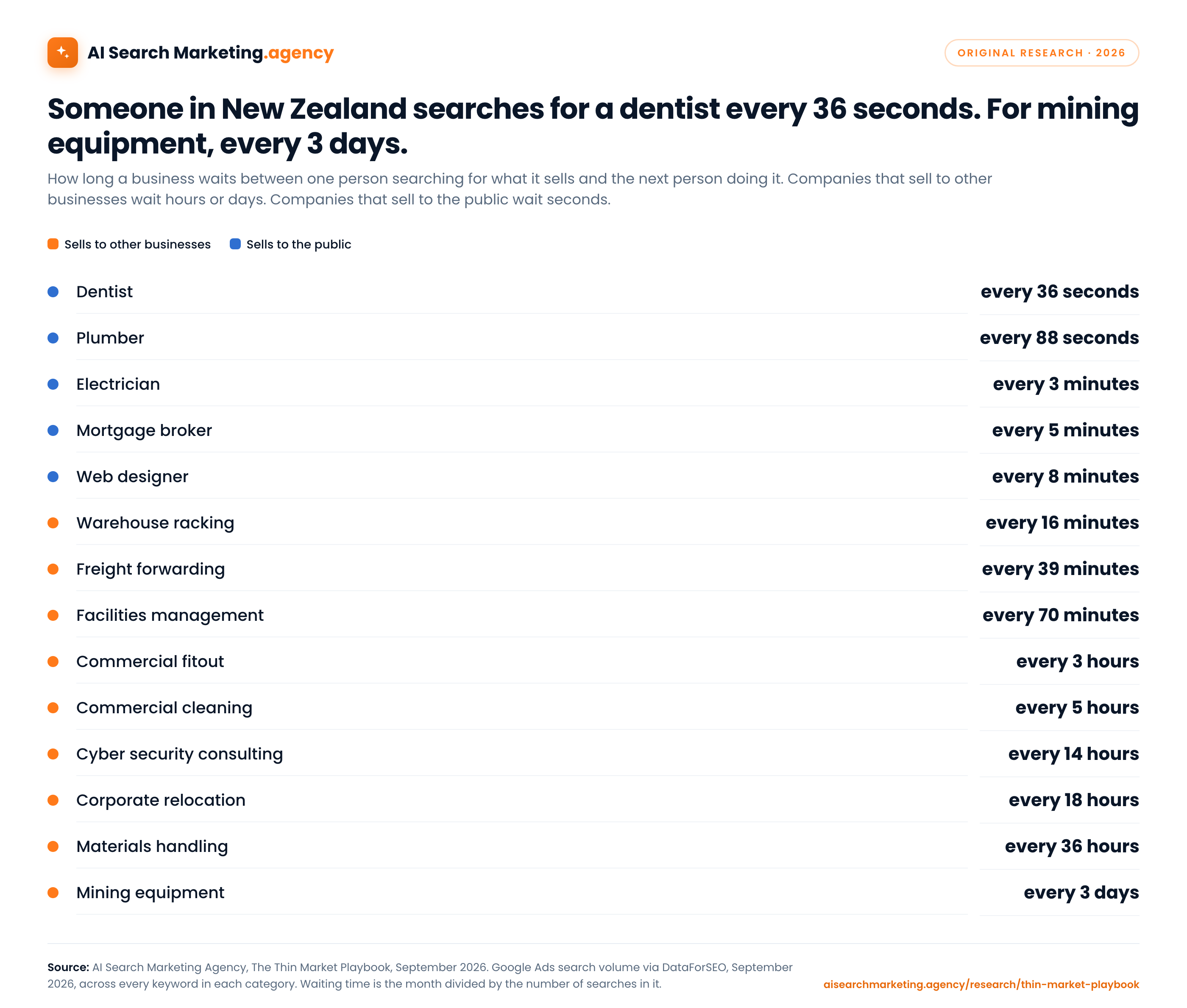
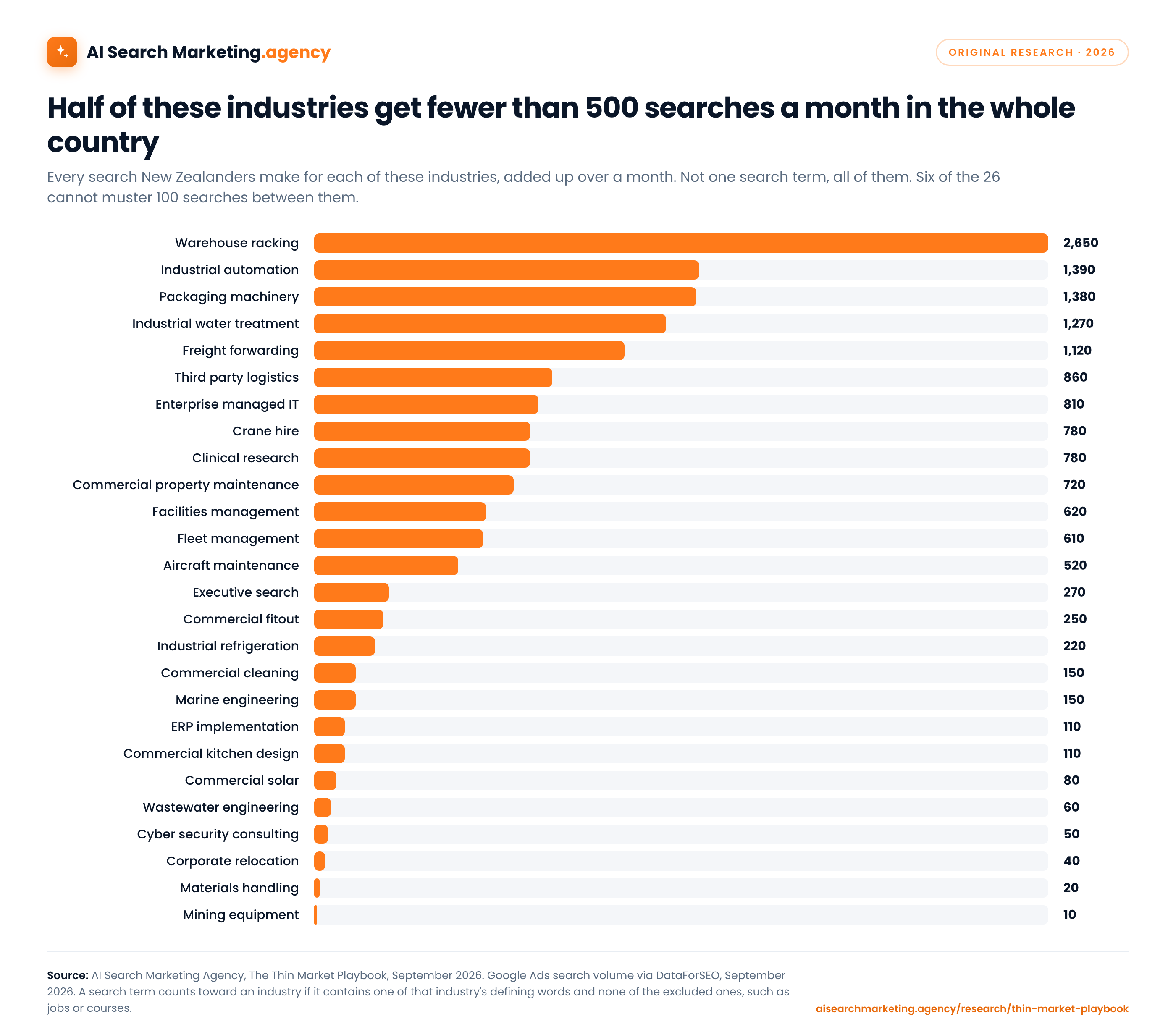
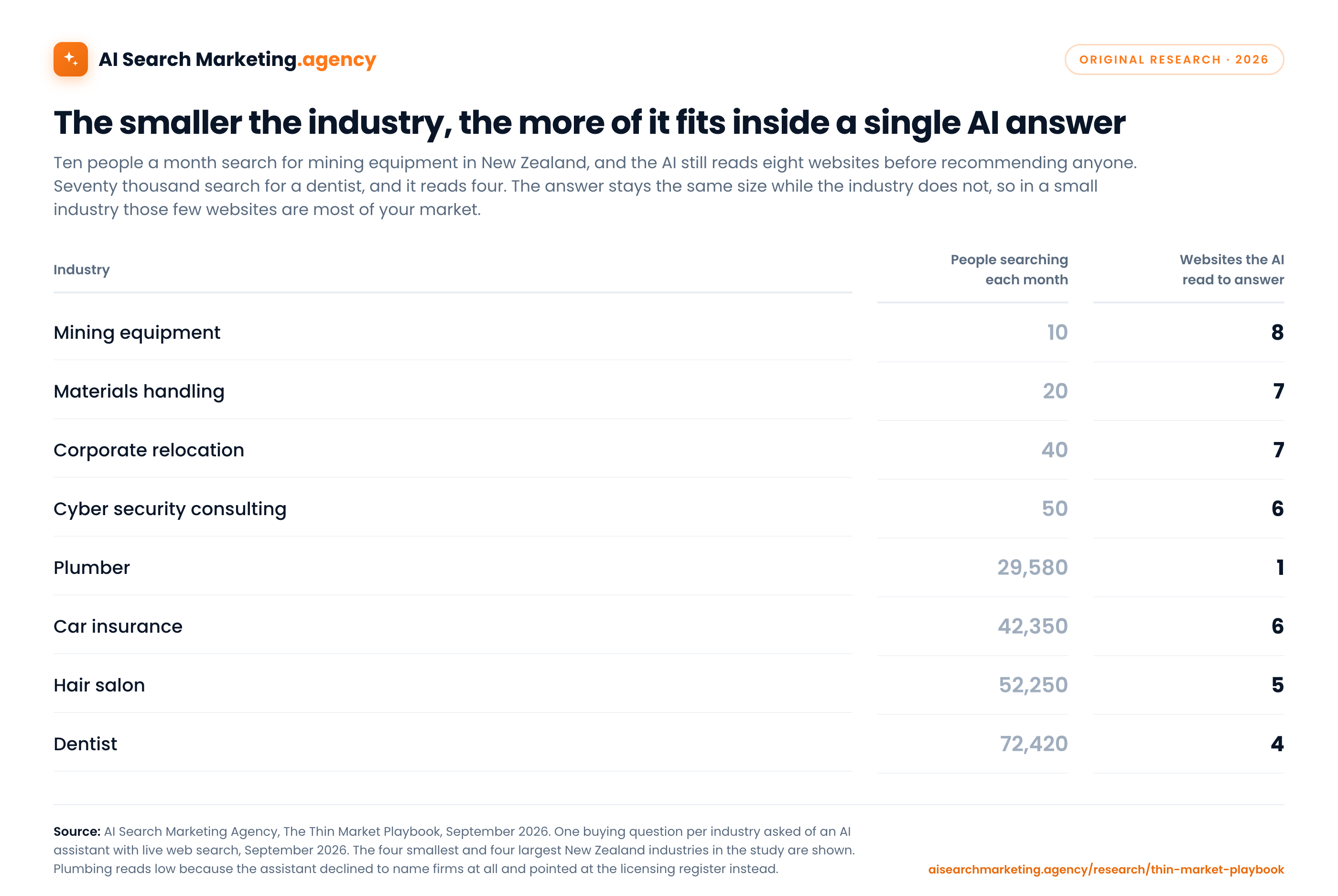
Somewhere in New Zealand this month, 10 people will search for mining equipment. Not 10,000. Just 10. Across every phrase, every spelling, every way of asking. That is the entire national search market for an industry that sells machines costing hundreds of thousands of dollars each.
20 people will search for materials handling. 40 for corporate relocation. 50 for cyber security consulting.
In the same month, someone will search for a dentist every 36 seconds.
We pulled the search data for 26 industries that sell to other businesses and 10 that sell to the public, across New Zealand, Australia, the United Kingdom and the United States. The gap between them is not a gap. It is a different world. The typical consumer business is searched for 70 times more often than the typical high value business supplier. In New Zealand it is 129 times more often.
And yet almost every piece of marketing advice ever written was written for the dentist.
The problem with advice written for busy markets
Rank first. Publish consistently. Build a content engine. Capture demand. Improve your conversion rate. Scale what works.
All of it assumes there is demand out there to capture. It assumes that if you get better at marketing, more people will find you, and if a lot more people find you, you will grow. That assumption is so basic that nobody writing the advice thinks to mention it.
For a great many businesses, it is simply not true.
If you sell commercial fitouts, industrial refrigeration, freight forwarding, executive search, packaging machinery or nationwide property maintenance, the demand is not out there waiting to be captured. There are perhaps a few hundred organisations in your country that could ever buy from you, and in any given month almost none of them are looking. Ranking first for everything would not fix that. It would just mean you own a very small thing completely.
We think this category of business deserves a name, because the advice it needs is genuinely different. Economists already have one. A thin market is a market with few buyers, few sellers and infrequent transactions. Nobody in marketing has claimed the term, and it fits precisely.
You are in a thin market if 4 things are true at once:
- Almost nobody searches for what you sell
- A single customer is worth a great deal
- The decision takes months and involves several people
- You could write down the names of every realistic buyer in the country
Those 4 travel together. Where you find 3 of them, the 4th is usually there too.
What search can actually do for you
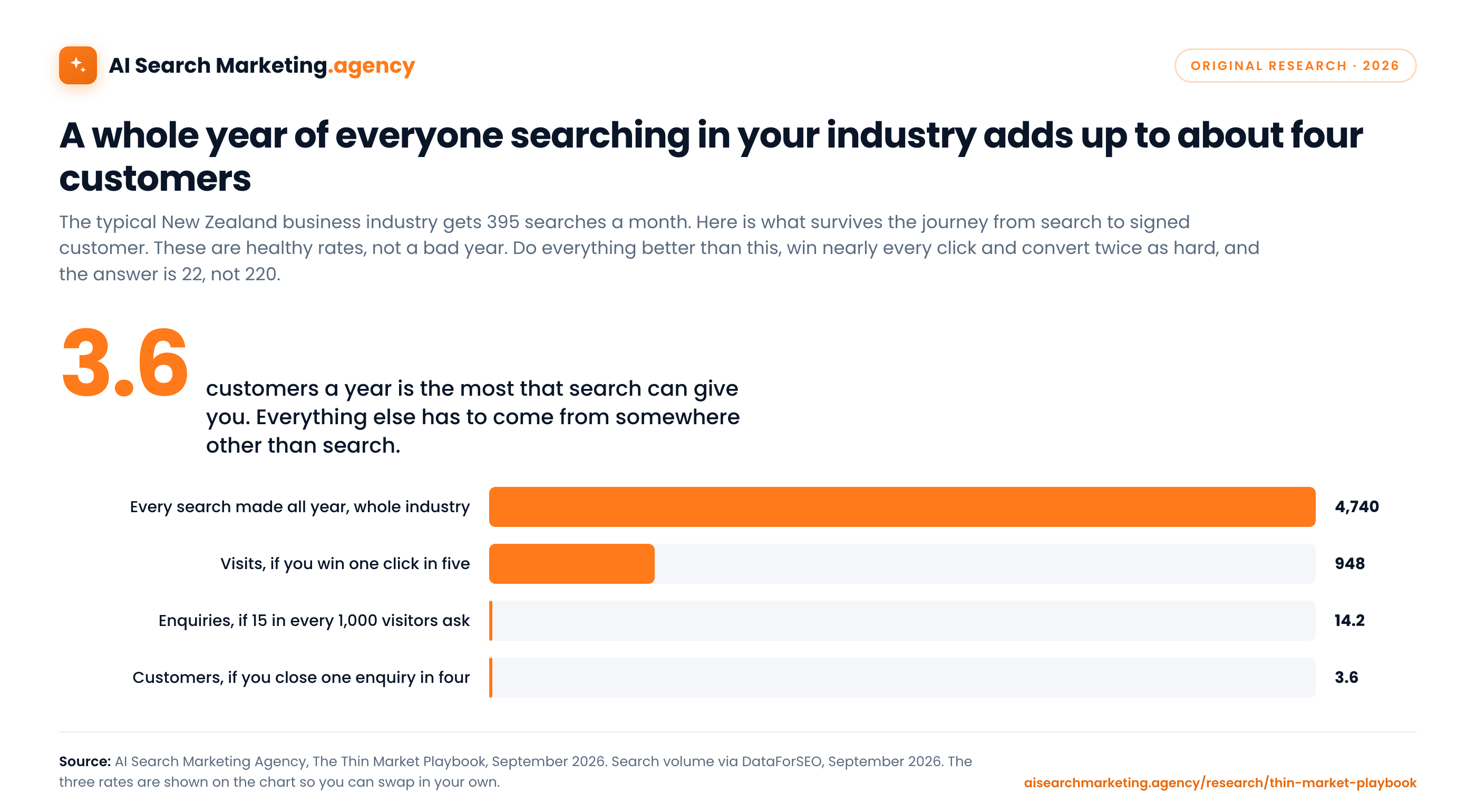
The typical business to business industry in our New Zealand data gets 395 searches a month across every keyword it has. That is 4,740 searches a year, from everybody, for every phrasing, including people who will never buy.
Win 20% of the clicks, which would make you the clear leader. Turn 15 visitors in every 1,000 into an enquiry, which is healthy for a considered purchase. Close 25% of those enquiries, which is good selling.
That is 3.6 customers a year.
Not in a bad year. That is the ceiling. Do everything better than this, take nearly every click and convert twice as hard, and the answer is 22, not 220.
Work out your own search ceiling
Pick your industry and market, or type your own number. The rates start at what a good operator would achieve, and you can change them.
That is the ceiling on search for your business. Whatever you need above that number has to come from proof, familiarity and direct account access. Open the calculator on its own page to share it or come back to it.
This is the number that should govern the marketing plan, and almost never does. Most businesses in this position are running a strategy built on the quiet hope that search will eventually deliver, while the arithmetic says it cannot. Search is worth doing. It is not worth planning around.
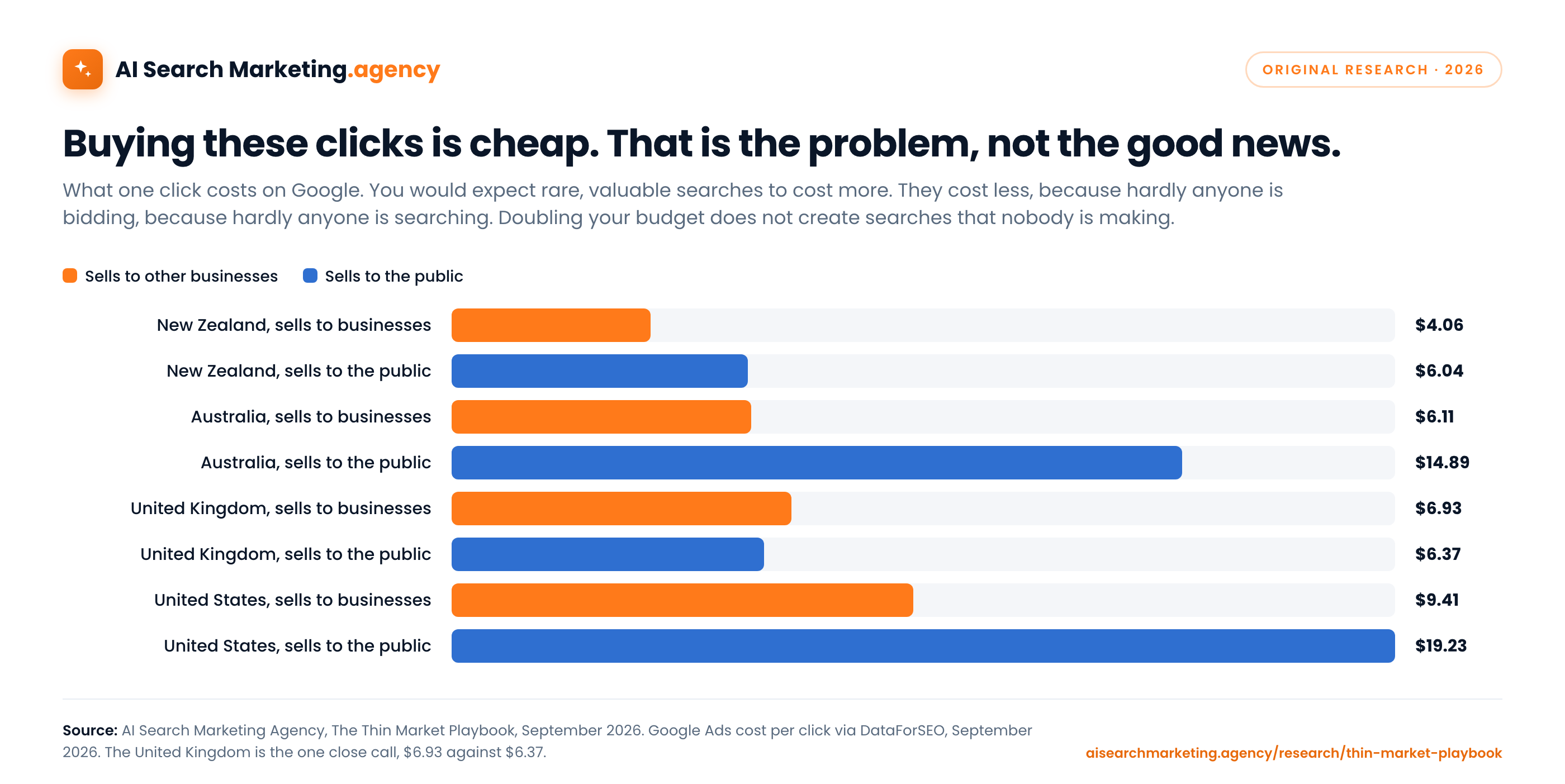
You cannot spend your way past it either. The obvious assumption is that rare, valuable searches must be expensive, and it turns out to be wrong. A click costs $4.06 in these New Zealand business industries and $6.04 in the consumer ones. In Australia it is $6.11 against $14.89. The clicks are cheap because hardly anyone is bidding, because hardly anyone is searching. A bigger budget buys the same few clicks at a worse price. It does not create searches that nobody is making.
So if search can only carry 3 or 4 customers a year, and money cannot buy more of it, the real question is what carries the rest. That is what the rest of this guide is about.
But first there is something happening in AI search that changes the shape of the problem, and almost nobody selling into these markets has noticed it yet.
Chapter 1: the answer machine has not made up its mind about you
We asked an AI assistant with live web search a simple buying question: which companies should I shortlist to do this work. We asked it for 36 industries across 4 countries, and then we asked the same question 5 times in a row, word for word identical, for a handful of them, to see whether the answer held still.
It did not.
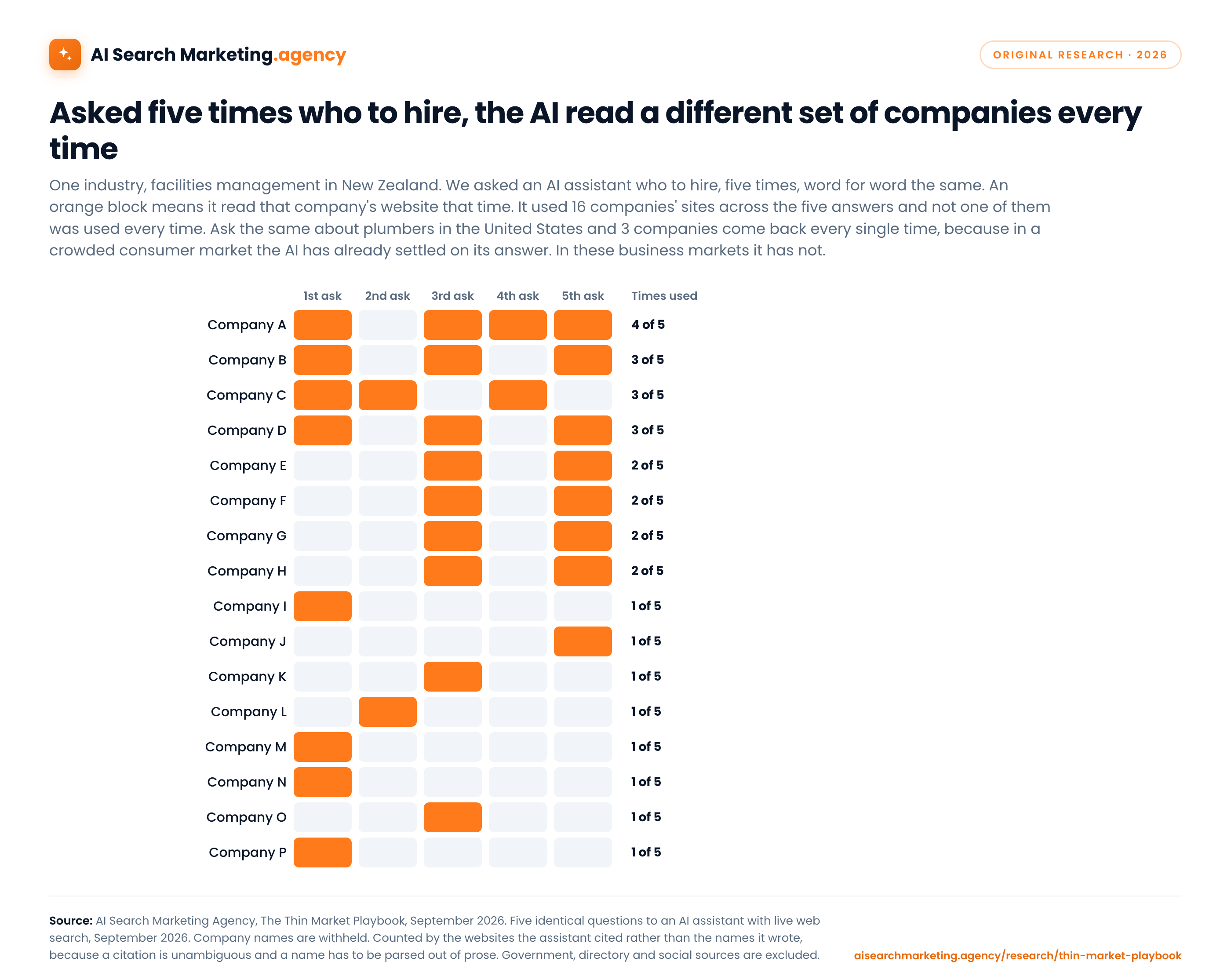
In facilities management in New Zealand, the assistant read 16 different companies' websites across those 5 answers. Not one of those 16 was used every time. The best any company managed was 4 appearances out of 5. 8 of them appeared exactly once.
Ask the same question about plumbers in the United States and 3 companies come back every single time, without fail.
That contrast held everywhere we looked. Across 6 industries that sell to other businesses, asked 5 times each, the assistant used an average of 16.3 companies' websites and not a single one appeared in all 5 answers. Across 6 industries that sell to the public, it used an average of 9.7 websites and 4 companies appeared every time.
In crowded consumer markets, the answer machine has settled. In thin business markets, it has not.
Why this matters more than a ranking ever did
If you have spent any time around search, your instinct is to ask how to rank in the AI answer. It is the wrong question, because there is no ranking to win. There is a pool of candidates, and each time somebody asks, the machine draws a handful from it.
That changes what you are optimising for. Not position. Two other things:
Being in the pool at all. If your website is not among the sources the assistant considers, you appear 0 times out of 5. No amount of quality fixes that, because you were never in the draw.
How often you come up. Once you are in the pool, appearing 4 times out of 5 rather than once is the whole game.
And here is the part that should change how you think about a buying committee. A serious purchase in these markets involves 4 or 5 people. If they each ask an assistant who to consider, and the assistant draws differently every time, then being in the pool gives you several chances to surface. Being outside it gives you none, no matter how many people ask.
The window, and how we know it is open
There is a reading of our data that sounds like bad news and is actually the opposite.
A machine that keeps changing its mind is a machine that has not chosen yet, and nothing is locked. In consumer categories the answer has already hardened around a few national names, and a new entrant is arguing with a machine that has made its decision. In thin business markets the machine is still looking around, still reading 16 different companies to answer one question, still changing its mind between one ask and the next.
That is what an open window looks like. It will not stay open.
We can also say something useful about where the assistant goes looking. Across all 4 countries we counted 672 different websites cited in those answers. Only 19 of them appeared in more than one industry. Everything else was a company's own website.
That is worth sitting with. The assistant is not primarily reading directories, listing sites or review platforms when it answers a business buying question. It is reading the providers themselves. The few cross industry sources that did appear split along exactly the line you would expect: consumer questions leaned on comparison media and trade directories, while business questions leaned on industry analysts.
So the lever is your own website. Not your listings, not your profiles, not a directory subscription. The pages you control are what the machine reads and uses.
What to do about it
The work is less exotic than it sounds, and most of it is overdue anyway. Some call it generative engine optimisation.
Answer the questions buyers actually ask, on your own site. Not "10 benefits of preventative maintenance". The real ones: how a national contract works across 50 sites, what response times are realistic, what this costs in this country, what happens when it goes wrong at 2 in the morning. The assistant is looking for pages that answer a buying question factually. Most of your competitors have published brochures instead.
Make the facts easy to lift. Coverage, sectors served, number of sites handled, accreditations, response commitments, years operating. Stated plainly, in text, on a page. Not inside a PDF, not baked into an image, not implied by a photo gallery.
Get corroborated somewhere that is not your own site. Industry analysts and trade bodies were the only third party sources the assistant reached for in these markets. One genuine industry citation is worth more here than 50 directory listings, which it appears not to read at all.
Stop measuring this as a ranking. If you check whether you appear in an AI answer, check several times over several weeks. One check tells you almost nothing, because one check is one draw. Appearing once is not success and missing once is not failure.
What we cannot tell you yet
We asked one assistant, in one phrasing, 5 times, in 6 industries across 2 countries. That is a probe, not a census. We do not know how far the pattern extends across other assistants, or how quickly a thin market hardens the way the consumer ones already have.
We also counted websites rather than company names on purpose. Names have to be pulled out of prose and that turned out to be unreliable in both directions, missing real companies in some answers and picking up stray phrases in others. A citation is unambiguous. Everything above is counted from citations, and the full set of answers is published with this guide so you can check the counting yourself.
Chapter 2: the 4 jobs that replace the funnel
The funnel assumes a flow. Strangers arrive at the top, some of them move down, a few come out the bottom as customers, and the job of marketing is to widen the top and reduce the leaks.
In a thin market there is no flow. There is a small, known population of possible buyers, almost none of whom are doing anything about it this month. Widening the top of the funnel means competing harder for 395 searches.
So instead of stages, think about 4 jobs. Each one answers a different question, each one fails in a different way, and a business that does 3 of them well and ignores the 4th tends to be stuck in a way that is very hard to diagnose from the inside.
Capture. Be there for the rare moment somebody is actually looking. Search, AI answers, local listings, a small amount of paid. This is the job that everybody already does, and it is the one with the hard ceiling.
Proof. Make the claim believable when they check you out. Case studies, evidence, numbers, references, credentials. This job decides whether Capture, Familiarity and Access convert into anything.
Familiarity. Be a name they already know before they need you. Repeated, low cost exposure to a small, defined audience over a long period.
Access. Reach the buyers who will never search at all, on purpose, by name. Outbound, account based marketing, partnerships, industry presence, original research.
Most businesses in this position spend almost everything on Capture, a little on Proof, nothing deliberate on Familiarity, and treat Access as the sales team's problem. Given the ceiling arithmetic, that allocation has it close to backwards.
A useful exercise: take last year's marketing spend, put every line item under one of the 4 headings, and add up the columns. The answer is usually uncomfortable.
Why the order matters
The 4 jobs are not a sequence, but they do depend on each other.
Familiarity without Proof produces a prospect who has heard of you and is not convinced. Access without Proof produces a meeting that goes nowhere. Capture without Familiarity means you show up as one unfamiliar name among several, in a decision where perceived risk is the deciding factor.
Proof is the one that multiplies the others. It is also, in our experience, the one that gets postponed indefinitely because it requires asking customers for permission, digging out real numbers and writing something specific.
Chapter 3: capture, done properly and cheaply
Capture has a ceiling. That is not a reason to do it badly. It is a reason to do it efficiently, get it finished, and stop pouring money into it.
Make your own site the thing the machine reads
Our data says the assistant answering a business buying question is overwhelmingly reading providers' own websites, not directories. So the highest value work is on pages you already control. Google's AI Overviews lean local in the same way: in my NZ Google AI Overviews Study, 80% of their citations went to .nz domains.
Write the pages that answer the questions a buyer asks in the week they are choosing. Not awareness content. Decision content:
- How does this work across multiple sites or regions
- What does it cost in this country, in ranges, with what drives the range
- What response times are realistic, and what happens outside business hours
- What does the handover look like if we are already with somebody else
- Who is accountable when something goes wrong
- What are the ways this goes badly, and how do you prevent them
Every one of those is a page. Each one is useful to a human buyer, to a search engine and to an AI assistant at the same time. Very few of your competitors have written any of them, because those questions feel like sales conversations rather than marketing.
State your facts as facts
Coverage, sectors, number of sites or clients handled, accreditations, response commitments, years operating, locations, certifications. Plain text on a page.
Not in a PDF. Not inside an image. Not implied by a gallery of photographs. If a fact about your business matters to a buyer, it should be a sentence that can be lifted and quoted without interpretation.
Paid search should be small and rude
Run search ads on the handful of genuinely commercial terms. Then use the ad copy to actively repel the wrong people.
If you only serve multi site commercial clients, say so in the ad. Say "commercial only", say "nationwide contracts", say "multi site". You will lower your click through rate and you should be delighted, because in a market this small the cost of a wasted enquiry is measured in your team's attention, not in the click.
Budget should be small enough that it is boring. There is no version of this where paid search becomes the growth engine, because there is nothing to buy.
Local, but only where you are genuinely local
If you have staffed locations, build proper local presence for them and collect reviews systematically. If you do not, do not manufacture 40 thin pages for towns you visit occasionally. They rank for nothing, they read as spam to a human, and they dilute the entity you are trying to establish.
Know when Capture is finished
Capture is a project with an end, not a permanent programme. When your money pages are written, your facts are stated, your schema is right, your listings are clean and your small paid campaign is running, you are done. Move the budget. If you want that work done for you, this is what my AI search optimisation service covers.
Chapter 4: proof, the job that gets postponed
Here is the situation from the buyer's side. They are considering replacing something that currently works, more or less. If the change goes badly it is visibly their fault. The supplier they are considering is making the same claims every other supplier makes. Nobody ever got fired for staying put.
Marketing that ignores this is just noise. Proof is the job of making the safe choice feel like the risky one.
Case studies beat blog posts by a distance
One specific, numerate case study is worth more than 10 general articles. It works in search, it works in AI answers, it works in a sales meeting, it works in a tender response, it works as an ad, and it works as the reason somebody replies to an email.
A case study that does the job contains, at minimum:
- The sector and the size of the problem, in numbers
- What was happening before, described honestly
- What you actually did, in enough detail to be credible
- What changed, measured, with the measurement named
- How long it took
- A quote from the person who was accountable
What kills case studies is vagueness. "Improved efficiency and reduced costs" tells a buyer nothing. "62 sites, 1 point of contact replacing 14 contractor relationships, average acknowledgement under 2 hours, 97% of jobs inside the agreed window, in place since 2022" tells them everything, including that you measure your own work.
If a client will not let you name them, publish it anonymised. "A national retail chain with 62 sites" still does most of the work.
Give every objection a URL
Write down the 10 things prospects say that slow deals down. Price, switching risk, coverage, capacity, what happens if a key person leaves, how you handle subcontractors, insurance, health and safety, exit terms.
Each of those should have a page that answers it properly. Not defensively. Just clearly, the way you would answer it in a meeting if you were being straight.
This is the cheapest sales enablement available, it makes your site useful to the machines reading it, and it shortens deals. When a prospect raises an objection, your salesperson sends a link instead of an argument.
Proof is also what makes Familiarity work
An audience that sees your name repeatedly and has no evidence behind it learns only that you advertise. The same audience seeing project outcomes, real numbers and named results learns that you do the work. Familiarity without Proof is expensive noise.
Chapter 5: familiarity, or being known before you are needed
Our own data makes the case better than any borrowed statistic. If an entire national industry produces 395 searches a month, then on any given day essentially nobody in your market is looking for you. They are busy running their operations, and their current arrangement is fine until suddenly it is not.
That moment, when the contract comes up, the incumbent fails badly, a new site opens or somebody new takes over the portfolio, is not predictable. You cannot market to it directly.
What you can do is arrange to be a name they already recognise when it happens.
Small audiences are an advantage here
Everything about thin markets is difficult except this. The audience you need to reach is small enough to be affordable, and if you have identified it properly you can stay in front of it more or less permanently for a modest, predictable budget.
Retarget everybody who visits the site. Build audiences from your customer and prospect lists. Run a continuous, low budget presence in front of the specific job titles at the specific companies that matter. It does not need to be a campaign. It needs to be a standing cost, like insurance.
Creative that builds memory, not leads
The instinct is to put a call to action on everything. Resist it, because you are not talking to people who are in the market today. You are talking to people who will be in the market at some unpredictable point in the next 3 years.
What you want lodged in their memory is 1 idea, expressed consistently enough that it sticks. Not your logo. Not "contact us for a quote". A single proposition, said the same way for long enough to become boring to you, which is roughly the point at which the audience starts to notice it.
Project photographs, before and after, real sites, real numbers and the occasional customer outcome do more here than anything designed to generate an enquiry.
Measure it as familiarity, not as response
Familiarity advertising that is judged on click through rate will be switched off within a quarter, because it will fail that test. It is not supposed to pass it. Its job is that when somebody finally does search, or finally does ask a colleague for a recommendation, your name arrives with a feeling of having been around.
Chapter 6: access, or reaching the ones who will never search
There are buyers in your market who will never type your category into a search box. They will renew with the incumbent, or they will ask 2 people they trust, or they will run a procurement process that you only hear about after it has been scoped by somebody else.
Search cannot reach them. Familiarity helps only if they were in the audience. The only way to reach them is to go and get them, deliberately, by name.
Write the list
In most thin markets the total realistic buyer universe is between 100 and 2,000 organisations. That is a list somebody can actually build.
Build it properly. Every organisation that has the scale, the geography and the type of estate or operation you serve. Then map the people inside them: the person who owns the budget, the person who owns the problem, and the person who will be blamed if it goes wrong. That is usually 3 to 6 names per organisation.
This list is the most valuable marketing asset most thin market businesses do not have. Everything else points at it. Familiarity advertising targets it. Outbound works it. Events invite it. Research gets sent to it.
Outbound that is worth receiving
Outbound in a market this small is not volume email. It cannot be, because you cannot afford to burn a list of 300 companies with something generic.
What works is having something genuinely worth sending: a piece of original research about their sector, a benchmark they can compare themselves against, an observation about their specific estate that shows you have looked.
This is where the 4 jobs join up. A proper case study and a piece of original research are Proof assets, Familiarity content and the reason an outbound email gets a reply, all at once. That is the compounding you are looking for, and it is why 1 substantial asset beats a content calendar.
Be where the small world gathers
Thin markets are small worlds. The same few hundred people go to the same conferences, sit on the same industry bodies, read the same 2 trade publications and move between the same employers.
Being a known participant in that world does more than most digital activity. It is also, conveniently, one of the few reliable ways to earn the kind of industry citation that our data shows AI assistants actually reach for.
Chapter 7: what to measure when traffic is the wrong number
If you take one thing from this guide into next quarter's reporting, take this. The standard marketing dashboard is actively misleading in a thin market. Sessions, impressions, click through rates and cost per click all measure volume, and volume is the thing you do not have and cannot get.
Reporting on them produces a monthly meeting where everybody looks at a flat line and concludes that marketing is not working, when in fact marketing is doing the only thing available to it.
Measure these instead.
Share of the answer. For your 10 most important buying questions, how often does your site get used by an AI assistant. Check repeatedly, not once, because one check is one draw. A move from appearing in 1 answer in 5 to 3 in 5 is real progress and no traffic report will show it.
Target account penetration. Of the organisations on your list, how many have somebody who has visited the site, opened an email, engaged with something, or taken a meeting. This is the number that tells you whether Access and Familiarity are working. It goes up slowly and it does not go back down.
Enquiry quality, not enquiry count. In this market 6 well qualified enquiries is a better year than 60 poor ones. Track what proportion of enquiries are genuinely in your addressable definition. If that proportion is rising while the count is flat, you are winning.
Influenced pipeline. Which opportunities had any marketing contact before sales got involved. Not attribution in the last click sense, which is meaningless across a 9 month decision with 5 people in it. Simply: did we touch this account before it became an opportunity.
Proof asset coverage. How many of your top objections and top sectors now have a published asset. This is an input measure rather than an outcome, but it is honest and it moves, which makes it a good thing to show a board while the slower measures build.
What to tell the board
Say it in advance, before the flat line arrives. The addressable search demand in this market is roughly X searches a year, which at realistic rates is Y customers. Our growth has to come from familiarity and direct account access, both of which take 2 to 4 quarters to show up. Here is what we will report in the meantime.
Setting that expectation at the start is the difference between a strategy that gets 3 years to work and one that gets cancelled in month 7.
Chapter 8: what to do first, and what to leave until later
The first 90 days
Fix Capture and finish it. Rewrite the money pages so they answer buying questions. State your facts as text. Clean up the technical basics and the structured data. Sort out listings where you are genuinely local. Launch a small, deliberately narrow paid campaign.
Start Proof. Pick the 3 best customer stories you are able to tell and get permission while you are thinking about it, because that is the step that stalls.
Build the list. Even a first draft of 150 target organisations changes how every other decision gets made.
Put measurement in place before you start, including a baseline of how often you appear in AI answers for your 10 key questions. You cannot show progress from a baseline you never took.
Months 3 to 9
Publish the case studies. Give the top objections their own pages. Build the sector pages that matter, based on where you actually win.
Turn on continuous familiarity advertising against the list and against site visitors. Keep it small and keep it running.
Begin deliberate outbound into the list, using the proof assets as the reason to make contact.
Start the 1 substantial original asset: a benchmark, a piece of sector research, something only you can publish because only you have the operational data.
Months 9 to 24
The goal here is not a ranking. It is to become one of the names that comes up automatically when somebody in your market considers changing supplier.
That means sustained presence in the small world: industry bodies, trade press, speaking, partnerships, an annual piece of research that people wait for. It means your case study library covering every sector you sell into. It means familiarity advertising that has been running long enough to have done its work.
It is slow, it compounds, and it is extremely hard for a competitor to copy quickly, which is the entire point.
Chapter 9: what we would not do
We would not commission 50 general blog posts. There is no volume to win and general articles do not answer buying questions.
We would not build location pages for towns we do not serve properly. They rank for nothing and they weaken the entity.
We would not bid broadly on generic category terms. Most of that traffic is the wrong buyer entirely, and in several of these categories a meaningful share is consumer intent wearing a commercial phrase.
We would not report on sessions. See chapter 7.
We would not try to look like the multinational. If the large incumbents in your category compete on scale, process and procurement comfort, copying their language makes you a smaller version of them, which is the worst available position. The useful position is usually the opposite of their weakness: direct access, accountability, speed, one person who owns the outcome.
We would not lead with "one stop shop". It sounds like a benefit and it makes you interchangeable, because every competitor says it.
We would not check an AI answer once and draw a conclusion. One check is one draw.
Chapter 10: what this looks like in practice
A composite, drawn from the pattern rather than from any 1 business.
A commercial maintenance company operating nationally, 40 staff, strong operational reputation, growth that has come almost entirely from referral and from 2 large relationships. The owners know that concentration is a risk. They have a website that describes their services, a blog nobody reads, and a growing sense that marketing does not work for them.
Their category gets a few hundred searches a month nationally. They rank on page 2 for a term with 40 searches. Their previous agency reported traffic growth.
What the diagnosis says. Their entire marketing effort sits in Capture, in a market where Capture tops out around 4 customers a year. They have no published proof despite having 10 years of it in their job management system. Nobody outside their existing relationships has heard of them. There is no list of the organisations they want to serve.
What they do first. They fix and finish the money pages, answering the questions their own sales conversations already contain. They publish 3 case studies using numbers pulled from their own operational data, which turns out to be the single most persuasive thing they have ever produced. They build a list of 220 organisations with the kind of estate they are built for.
What they do next. Continuous, small familiarity advertising against those 220 organisations and everybody who visits the site. Outbound into the list, using the case studies. Their operations manager starts showing up at the industry body.
What happens. Traffic barely moves. Enquiry volume barely moves. Enquiry quality changes noticeably inside 2 quarters. Their appearance rate in AI answers for their main buying questions goes from almost never to roughly half the time, because they are now the only company in their category with real answers published on their own site. Somewhere in month 8, a national operator that has been receiving their material for 6 months has a bad experience with an incumbent, and calls them directly.
That deal does not have a traceable source. It came from all 4 jobs working at once, which is exactly why the standard dashboard could never have predicted it.
How this study was done
We selected 26 industries that sell to other businesses and 10 that sell to the public, and sorted them into those 2 groups by hand before collecting any data, so that the split could not be shaped by the results.
For each industry and each of the 4 countries we collected the full set of search terms and their monthly search volumes and costs per click. A term counts toward an industry if it contains 1 of that industry's defining words and none of the excluded ones, such as jobs, courses, salaries or definitions. Those rules were fixed before collection. Close variants that carry identical volume and cost are counted once, because leaving them in would have inflated the consumer categories and flattered our own argument.
For the AI work we asked an assistant with live web search a single buying question for every industry in every country, and then repeated the identical question 5 times each for 6 industries in 2 countries. We count the websites the assistant cited rather than the company names it wrote, because a citation is unambiguous and a name has to be parsed out of prose, which we found unreliable in both directions.
Everything is published: the search volumes, the AI answers, the repeated questions and the counts behind every chart. If you think we have it wrong, the data is there to check.
The data
Everything behind the charts, free to use with attribution under CC BY 4.0. If you think we have any of it wrong, the files are here to check.
- Every AI answer we collected144 answers, one buying question per industry per market, with the websites each one cited.
- The same question asked 5 times60 answers, 6 industries in 2 markets, for checking how much the shortlist moves.
- Search volumes and costs36 industries across 4 markets: total searches, main term, cost per click.
- What the AI recommendedWebsites cited and companies named for every industry and market.
- How many providers existBusinesses listed on Google in each industry, with the caveats stated in the file.
Not sure whether you are in a thin market?
The free AI Visibility Audit shows how much demand your industry actually has, and whether AI assistants are recommending you when buyers ask.
Book Your Free Audit